Changes to biodiversity and landscape
By generating renewable energy and investing new renewable generation assets, Repower makes a relevant long-term contribution to protecting biodiversity and the landscape, although the company’s installations and their operation also impact them.
Impacts
Repower believes it has a responsibility to guarantee its customers an uninterrupted energy supply as far as possible while minimising and continuously reducing the impact on biodiversity and the landscape. Hydropower plants, wind and solar power installations, and energy distribution infrastructure affect animal and plant habitats and the landscape. Energy generation and distribution equipment can be perceived as a foreign body in the landscape and impair the sense of wellbeing and being in nature. They also impact animal and plant habitats. For example, hydropower plants can hinder fish navigation, wind farms can endanger birds and bats, and power lines can pose a danger to birds with large wingspans.
Risks
Changes to the landscape and habitats caused by the expansion of renewable energy can be perceived negatively by local residents and lead to reputational risks for Repower. The environmental impact of new energy generation and distribution facilities is assessed as part of the approval process. In the event of potentially adverse effects on habitats, approvals may be delayed, projects may need to be adjusted or applications may be rejected altogether.
Risks of causing environmental damage and failing to consider the landscape adequately are a component of the Repower Group’s risk and control assessment (see Introduction).
Guidelines and due diligence
Repower Switzerland has an environmental management system certified in accordance with ISO 14001 in place. The integrated management system committee is responsible for defining and achieving the relevant targets. SET S.p.A., the operator of Teverola gas-fired combined cycle power plant, also has an ISO 14001-certified environmental management system and is registered with the European Eco-Management and Audit Scheme (EMAS). At the beginning of each three-year cycle, the management of the Teverola plant formulates an environmental programme (see Water use).
Measures
The biodiversity and landscape aspects of new power plants and energy distribution facilities, as well as the renovation of these assets, are analysed in an environmental impact assessment. On this basis, target states are defined and corresponding measures are determined.
The continuous renewal of the installations means that the impact can be continuously reduced. The power grid is professionally maintained and, where it is possible and makes sense, made less susceptible to environmental influences by running cables underground. In 2025, Repower helped enhance the landscape in the canton of Graubünden by removing 165 wooden poles and six concrete, lattice and steel pylons. Existing overhead lines are also continuously being equipped with bird protection mechanisms.
Repower Italia initiates targeted projects for the landscape and ecological enhancement of solar and wind power plants. These activities are guided by the United Nations’ sustainability goals (see Annex) and the EU’s Nature Restoration Law. The aim is to use energy landscapes not only as production sites, but also to develop them as catalysts for ecological regeneration. Particular attention is paid to the integration of technology-based plant components with nature-based solutions. This creates a system in which the energy infrastructure actively contributes to the restoration of ecosystems and the promotion of biodiversity. Project measures include the creation of forest infiltration areas, the establishment of habitats for wild animals, the morphological restoration of canals to create wetlands, the planting of diverse rows of trees, the creation of flower strips for pollinators, and the testing of new management approaches to improve soil quality.
Some wind farms in Italy are monitored for their impact on birds to check whether the turbines cause changes in the local fauna. Fish fauna is monitored at numerous hydropower plants.
Project to dismantle the Lietha plant
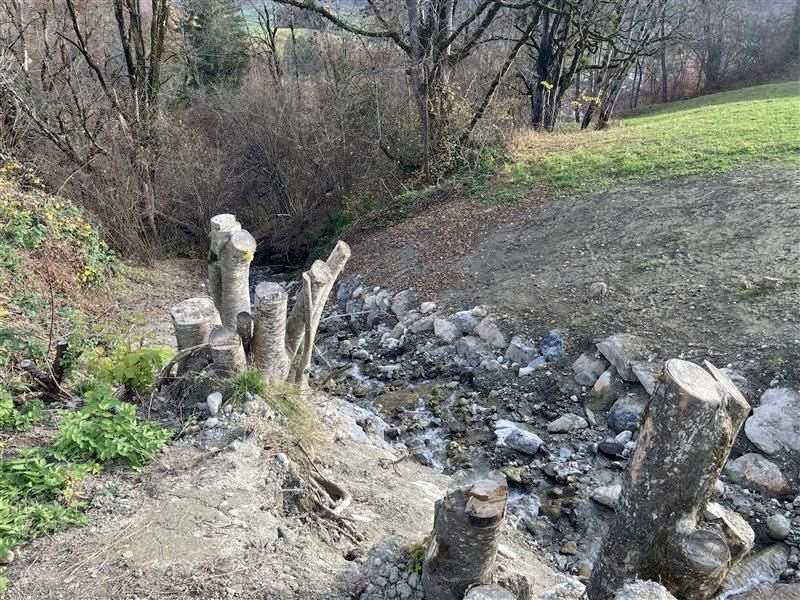
The demolition of the former Lietha power plant in Grüsch marks the end of a 120-year chapter of industrial water use. Demolition work began in 2025 and is expected to be completed by summer 2026. Selected historical components, including the transformer tower, will be preserved as cultural and historical artefacts. Parallel to the dismantling, the streams and banks of the Taschinasbach and Flensabach will be ecologically upgraded. In addition, the section of the watercourse below the Prada basin, which had previously been culverted, will be re-exposed and redesigned to be more natural.
Stakeholder engagement
When planning new projects or renovations, Repower Switzerland involves the relevant stakeholders at an early stage. It is important for Repower that local interests also be represented. In the case of new power plants and facilities, the environmental impact assessment is carried out with the involvement of various specialists and the environmental organisations. The final measures are determined by the authorities. For example, a support group was set up for the Chlus project with representatives of various stakeholder groups, such as environmental protection organisations, associations and authorities. The support group is regularly informed about planned measures and can bring its concerns directly to the project managers. The concerns presented are examined and acted upon if possible.
Teverola combined-cycle gas turbine power plant publishes an updated environmental statement every year (see Water use).