INTRODUCTION
Value chain
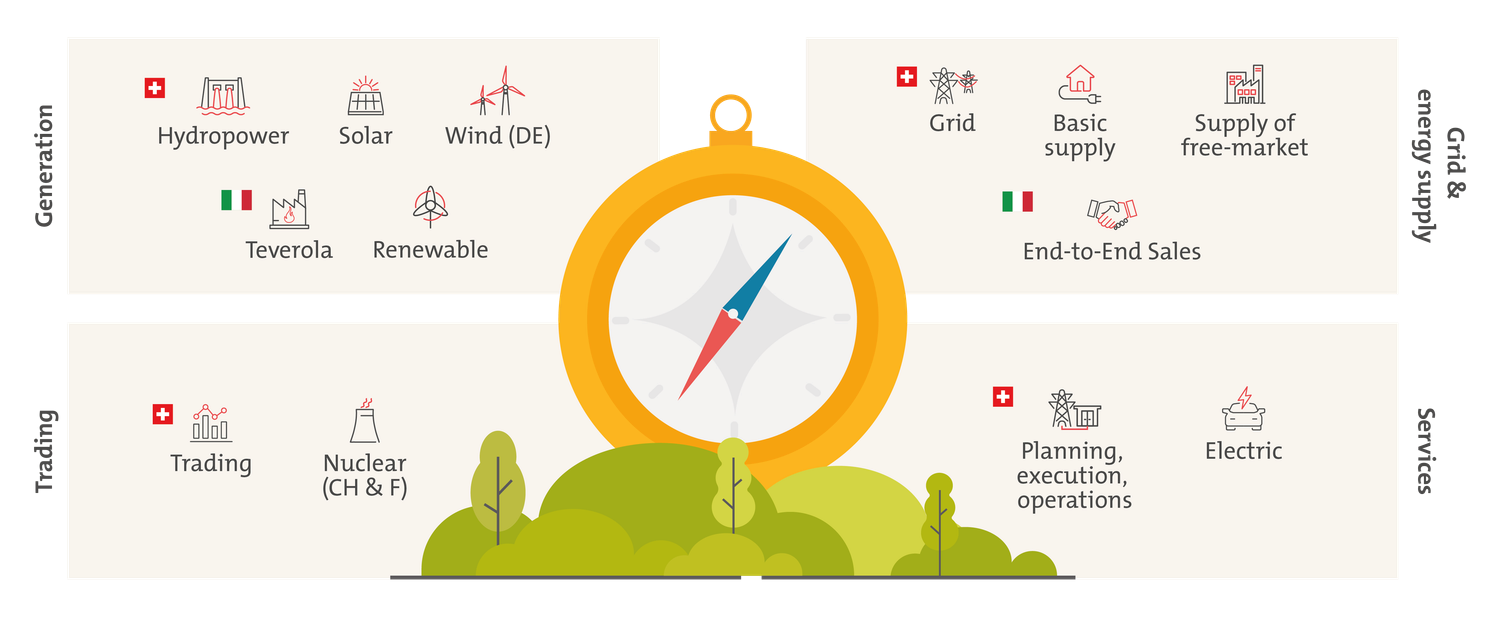
Repower operates along the entire electricity value chain from generation and trading to distribution and sales. The company generates electricity in Switzerland, Italy and Germany at its own power plants and through interests. A large part of the electricity it generates is from hydropower facilities in Graubünden. With an electricity grid with a total length of more than 3,000 kilometres, Repower is the largest distribution grid operator in Canton Graubünden. The company is also represented at the most important Central European trading centres for electricity, gas and certificates. It provides customised energy solutions for free-market customers, energy utilities and infrastructure operators.
Approach to sustainability and material topics
Repower is well aware of its economic, environmental and social responsibility and endeavours to act sustainably for the long term. To identify the material economic, social and environmental topics for the company, in 2023 Repower conducted a double materiality analysis. This takes account of the company’s impact on people and the environment (materiality of impact) and the risks and opportunities for the company (financial materiality). From a selection of around 200 topics, twenty potentially important topics for Repower were evaluated in two internal workshops. These topics formed the basis of two online surveys. Our most important external stakeholders were asked about the Repower’s impact on people and the environment. The respondents included customers, suppliers, shareholders, cantonal and municipal authorities, NGOs, the media, banks and the sales network in Italy. The second survey was conducted among Repower’s divisional heads to identify the most important risks and opportunities. The results of the two surveys were discussed in individual meetings with the members of the executive board. Eight material topics were ultimately identified and approved by the executive board. To take appropriate account of changes in the operating environment and the ongoing development of Repower Group, a review of the material topics is planned in the next two years.
The eight material topics for Repower described below were linked to the four United Nations Sustainable Development Goals (UN SDGs) to which Repower contributes. Repower has selected the following priority SDGs: “Access to affordable, reliable, sustainable and modern energy for all” (SDG 7), “Sustainable economic growth and decent work” (SDG 8), “Climate action” (SDG 13) and “Life on land” (SDG 15). An overview of all United Nations Sustainable Development Goals can be found in the Annex.
Our contribution
In generating 100 per cent renewable energy in Switzerland and expanding its renewable energy generation facilities in Italy, Repower is actively contributing to the energy transition and security of supply in both countries.
Material topics
Our contribution
Repower acts prudently to safeguard the existence and ongoing development of the company and create financial value.
Repower creates secure jobs and provides good working conditions, attaching great importance to occupational health and safety.
Indirectly, Repower also creates economic growth in the regions in which it operates by awarding contracts to third parties.
Material topics
Our contribution
One hundred per cent of Repower Switzerlandʼs own electricity production comes from renewable resources. Repower Italia will continue to substantially increase the proportion of renewables in the future. In this way, Repower is helping to reduce greenhouse gas emissions in electricity generation.
Repower has various offerings designed to raise its customers’ and business partners’ awareness of climate and environmental protection.
Material topics
Our contribution
Repower acts prudently to minimise the negative impact of electricity generation and distribution on biodiversity on land and in water and, by producing renewable energy, contributes to the energy transition and thus to the protection of biodiversity in the long term.
Material topics
Reporting
The 2025 sustainability report has been prepared with reference to the GRI (Global Reporting Initiative) Standards. At its core are the eight material topics. The topics “Respect for human rights” and “Ethical business behaviour”, based on the requirements of Art. 964b of the Swiss Code of Obligations, are additionally addressed. Repower continues to address these topics in the report even though it is not obliged to do so.
The material topics are presented in the order of the United Nations Sustainable Development Goals. In line with the requirements of the GRI Standards and Art. 964a ff. of the Swiss Code of Obligations, the topics include Repower’s impact on people and the environment, the risks for Repower, the relevant guidelines and due diligence, and the measures taken. Where relevant, this is followed by details of the stakeholders and the measurement of effectiveness.
Risk management
The Repower Group has developed and implemented a risk management policy designed to ensure that management makes informed decisions by taking an integrated, comprehensive and forward-looking view to assess and analyse risks in the short, medium and long term. As part of its established risk and control assessment (RCA), every year the Repower Group identifies, assesses and monitors over 30 risks related to business operations / strategy, compliance, financial reporting and market / credit. In addition to financial risks, environmental and social risks are systematically analysed and managed. Particular attention is paid to the top risks in connection with our corporate strategy. Critical issues are also regularly analysed and evaluated. Examples include the failure of generation facilities and power supply systems, fluctuations in energy prices, changes in political conditions, changes in the availability of natural resources, project delays, labour law and safety risks, as well as risks related to human resources and corporate social responsibility.